ADVOCATING FOR THE SAFETY OF CHILDREN WORLDWIDE
RESEARCHING THE DANGERS TO ENSURE THE SAFETY
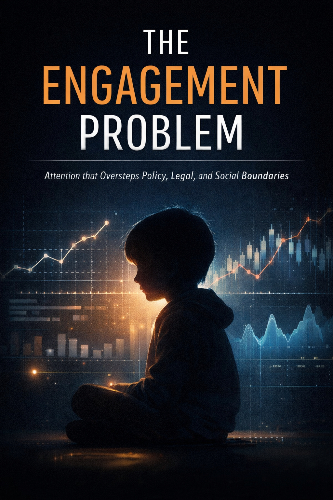
THE ENGAGEMENT PROBLEM
Attention that Oversteps Policy, Legal and Social Boundaries
Book Summary
The Engagement Problem: Attention that Oversteps Policy, Legal and Social Boundaries examines a critical blind spot in how online platforms interpret success—especially when children are involved.
On YouTube, engagement metrics such as views, likes, watch time, replay behaviour, and comments are treated as indicators of growth and achievement. Higher engagement is assumed to be positive. Algorithms reward it. Creators are encouraged to pursue it. Yet when the subject of content is a child, this assumption can be dangerously misleading.
This book introduces the engagement problem: attention resulting from an intention that oversteps policy, legal, or social boundaries.
Rather than focusing on explicit content violations, The Engagement Problem shows how risk often emerges through patterns of attention—long before any rules are broken. A video can be compliant, ordinary, and well-intentioned, yet still attract attention that is inappropriate, fixated, or exploitative in nature. When this happens, high engagement is not a success signal. It is a warning.
Using YouTube’s own metrics, the book provides a clear, structured framework for identifying when engagement may signal safeguarding risk rather than healthy interest. It explains how individual metrics function, why single metrics are insufficient, and how specific combinations—such as high views with low watch time, or high replay points with strong reinforcement—can reveal problematic attention. Channel-level data and viewer behaviour are examined to distinguish isolated anomalies from emerging patterns.
Special attention is given to comments as attempted two-way contact, the hidden risks of silent consumption, the unintended consequences of disabling feedback, and how thumbnails and auto-generated visuals can amplify inappropriate focus. The book also explores returning viewers and audience concentration as early indicators of fixation.
Written for parents, guardians, policymakers, researchers, and platform designers, The Engagement Problem reframes engagement metrics as protection metrics—tools for early visibility, not just performance measurement.
This is not a call to remove children from online platforms. It is a call to read the signals that already exist.
The data is already there. The risk is already present.
Safeguarding begins when we stop treating engagement as neutral.
ADVOCATING FOR THE SAFETY OF CHILDREN WORLDWIDE