ADVOCATING FOR THE SAFETY OF CHILDREN WORLDWIDE
RESEARCHING THE DANGERS TO ENSURE THE SAFETY
WHAT WE DO
PUBLISH RESEARCH
We research different vulnerabilities children face online and publish the research in easy-to-understand books.
SECURITY THROUGH AWARENESS
We teach children how to protect themselves and parents how to protect their children.
RESEARCH
EXPLORE THE RESEARCH
BOOKS
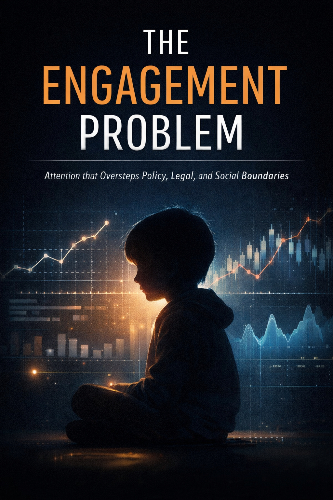
THE ENGAGEMENT PROBLEM
Attention that Oversteps Policy, Legal and Social Boundaries
Book Summary
The Engagement Problem: Attention that Oversteps Policy, Legal and Social Boundaries examines a critical blind spot in how online platforms interpret success—especially when children are involved.
On YouTube, engagement metrics such as views, likes, watch time, replay behaviour, and comments are treated as indicators of growth and achievement. Higher engagement is assumed to be positive. Algorithms reward it. Creators are encouraged to pursue it. Yet when the subject of content is a child, this assumption can be dangerously misleading.
This book introduces the engagement problem: attention resulting from an intention that oversteps policy, legal, or social boundaries.
Rather than focusing on explicit content violations, The Engagement Problem shows how risk often emerges through patterns of attention—long before any rules are broken. A video can be compliant, ordinary, and well-intentioned, yet still attract attention that is inappropriate, fixated, or exploitative in nature. When this happens, high engagement is not a success signal. It is a warning.
Using YouTube’s own metrics, the book provides a clear, structured framework for identifying when engagement may signal safeguarding risk rather than healthy interest. It explains how individual metrics function, why single metrics are insufficient, and how specific combinations—such as high views with low watch time, or high replay points with strong reinforcement—can reveal problematic attention. Channel-level data and viewer behaviour are examined to distinguish isolated anomalies from emerging patterns.
Special attention is given to comments as attempted two-way contact, the hidden risks of silent consumption, the unintended consequences of disabling feedback, and how thumbnails and auto-generated visuals can amplify inappropriate focus. The book also explores returning viewers and audience concentration as early indicators of fixation.
Written for parents, guardians, policymakers, researchers, and platform designers, The Engagement Problem reframes engagement metrics as protection metrics—tools for early visibility, not just performance measurement.
This is not a call to remove children from online platforms. It is a call to read the signals that already exist.
The data is already there. The risk is already present.
Safeguarding begins when we stop treating engagement as neutral.

CHILDREN ON YOUTUBE
A Parent’s Guide to Protecting Young Content Creators
Book Summary
Children on YouTube explores what happens when children move from watching online content to creating it.
While much attention is given to what young people consume online, far less guidance exists for parents whose children appear on screen. This book addresses that gap by examining how visibility, attention, and interaction work on platforms like YouTube—and how these systems affect young content creators in ways that are not always obvious.
Rather than focusing on rare or extreme cases, the book looks at everyday patterns: how different types of content attract different audiences, how familiarity builds over time, where boundaries quietly blur, and why interaction can escalate even when intentions are innocent. Throughout, the emphasis is on understanding systems, not blaming children or restricting creativity.
Written in a calm, accessible tone, Children on YouTube helps parents recognise where risks arise and how small, practical habits can significantly reduce exposure. It offers guidance on supporting children without controlling them, keeping conversations open at home, and helping young creators develop awareness and confidence in public digital spaces.
This book is designed for parents, educators, and schools seeking a thoughtful, non-alarmist approach to safeguarding—one that recognises that creativity and safety can coexist when visibility is understood.
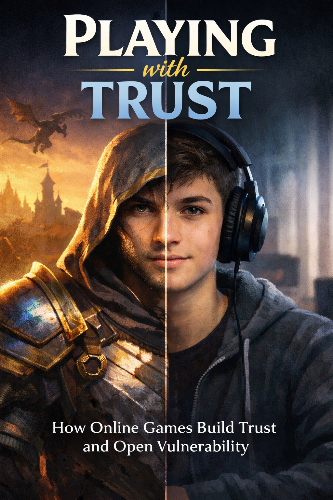
PLAYING WITH TRUST
How Online Games Build Trust and Open Vulnerability
Book Summary
Online games are no longer just entertainment. They are social worlds where friendships form, trust develops, and relationships can carry real emotional weight—especially for young people.
Playing with Trust explores how trust is built in online gaming environments, and why those same trust-building processes can quietly open vulnerability over time. Rather than focusing on extreme cases or fear-based warnings, this book explains the mechanisms through which trust forms naturally: cooperation, shared goals, long hours of interaction, group belonging, and carefully curated online identities.
By tracing the evolution of online interaction—from early chatrooms to modern multiplayer games—the book shows how gaming takes familiar social processes and intensifies them. Players do not just talk; they act together, rely on one another, and build shared history. Trust feels earned, reasonable, and safe—often long before it is consciously examined.
The book explains why online masking is easier than in-person, how avatars and in-game roles shape perception, and why consistency over time can become a false signal of safety. It also explores common trust pathways that create vulnerability, not through recklessness, but through normal human responses to care, familiarity, and belonging.
Importantly, Playing with Trust is not about discouraging online gaming or promoting suspicion. It is about awareness. It teaches young people how to think clearly about trust, how to maintain boundaries without guilt, and how to recognise influence without fear. For parents and educators, it provides a calm, structured framework for understanding risk without resorting to surveillance or restriction.
ADVOCATING FOR THE SAFETY OF CHILDREN WORLDWIDE